
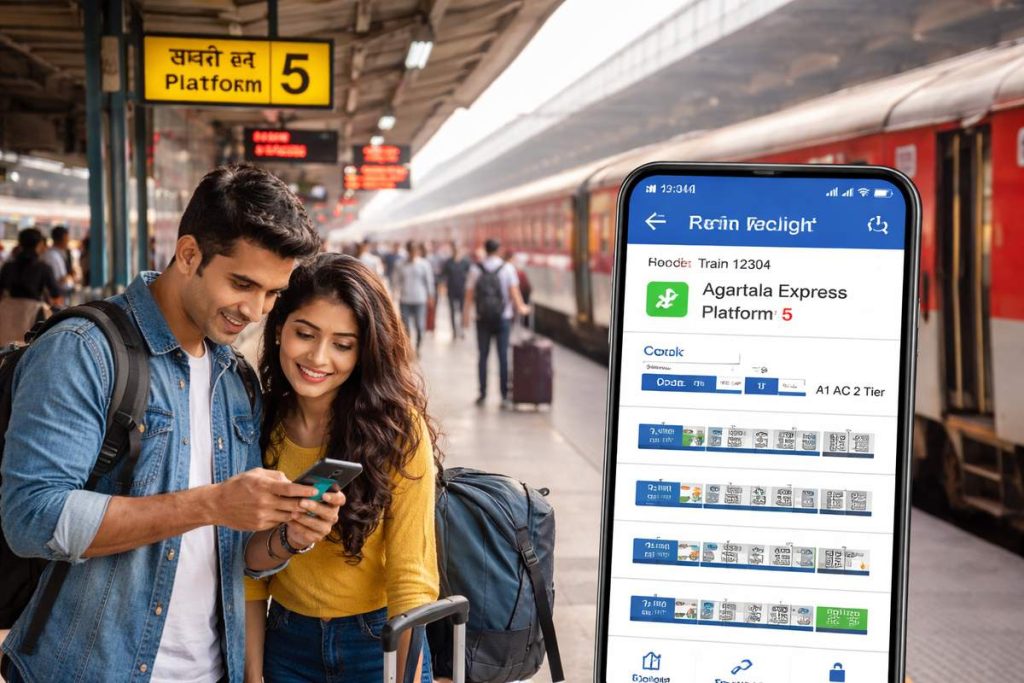
You can have a confirmed ticket, a reserved seat, and still start your train journey in pure panic.
You arrive at the station just in time—only to realise your coach is parked at the extreme end of a long platform. Bags in hand, announcements blaring, people everywhere. You sprint, hoping the train doesn’t move before you reach your door.
Most travellers think planning ends with a successful train booking.
Seasoned train travellers know better.
The most important part of the journey happens in the final 15–20 minutes before boarding.
And there’s one small habit that separates calm travellers from stressed ones.
They always check live platform number and coach position before stepping onto the platform.
Why “Where” Matters More Than “When”
In Indian Railways, last-minute changes are common—especially at busy junctions.
Even if you’ve been tracking the train’s running status for hours, a sudden platform change can undo all your planning. A train may be perfectly on time and still arrive on a completely different platform. Stations often reshuffle platforms at the last moment to manage traffic, congestion, or cascading delays.
So if you’re calmly waiting on Platform 3 while your train silently pulls into Platform 5, the next few minutes turn chaotic—dragging luggage up footbridges, weaving through crowds, and rushing down stairs against the clock.
That’s why experienced travellers don’t depend only on station boards or muffled announcements. They check live updates on their phone, so they know exactly where to stand before the train arrives.
Why Coach Position Can Make or Break Boarding
Long-distance trains today can stretch to 22–24 coaches.
Standing at the wrong end of the platform means:
- Running with luggage
- Boarding a moving train
- Or squeezing through narrow aisles inside
If your booking is in AC 2 Tier (A1) and you’re standing near the general or sleeper coaches, the boarding experience quickly turns uncomfortable.
Most long-distance trains follow a predictable layout:
- Engine: Front
- General coaches: Front or rear
- Sleeper coaches: Middle to rear
- AC 3 Tier: Middle
- AC 2 Tier & 1st Class: Close together
- Pantry car: Usually central
Knowing this in advance lets you stand near the coach indicator pole, place your luggage down, and simply wait.
The train comes to you—not the other way around.
The Reality of Delays (And Why Live Data Helps)
Railway infrastructure has improved rapidly, but long-distance trains still face delays.
On average, mail and express trains continue to run 30–40 minutes late on many routes. Some corridors have improved, others still face congestion—especially during peak travel hours.
Live running status changes fast. A train delayed by an hour can suddenly pick up speed and arrive early.
That’s why experienced travellers refresh the running status regularly instead of assuming the delay will stay the same.
Boarding Has Gone Digital—Your Habits Should Too
There was a time when travellers crowded around printed charts pasted on coaches.
Today, everything is digital:
- Seat status
- Coach layout
- Berth position
- Platform updates
Knowing your exact berth type—Side Lower, Upper, or Middle—before the train arrives helps you plan where to keep bags and how to settle in quickly.
Small details, big comfort difference.
Simple Habits That Make Boarding Stress-Free
Smart travellers follow a few simple rules:
- Check the last crossed station, not just the ETA
- Re-confirm platform number as you enter the station
- Watch for train direction changes, especially at junctions
These checks take seconds but save a lot of stress.
A Better Way to Start the Journey
Train travel in India is special—the views, the food, the conversations, the slow shift of landscapes.
But it shouldn’t begin with panic.
Checking your platform number and coach position just five minutes before arrival gives you control over the most chaotic part of the journey.
It’s a small habit.
And it’s the one thing that truly defines a smart train traveller.
Next time, skip the sprint—and enjoy the walk.