
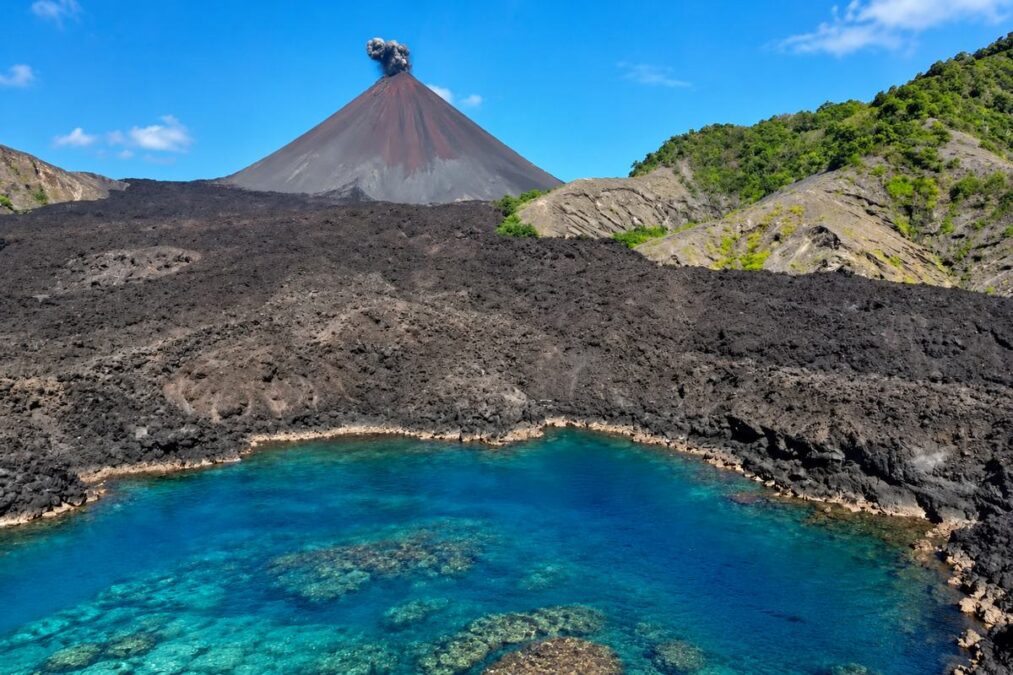
There is another reason Barren Island deserves attention today. Coral reefs across the Andaman and Nicobar region are facing increasingly frequent periods of marine heat stress and bleaching risk, yet recent underwater photography and dive reports from Barren continue to show striking colour and substantial coral growth at several sites. That does not make the reef immune to climate change, but it makes the island an especially interesting place to observe the contrast between an active volcano above the sea and a living reef beneath it.
Barren Island at a Glance
| Feature | Details |
|---|---|
| Location | Andaman Sea, northeast of Sri Vijaya Puram, Andaman and Nicobar Islands |
| Latitude / Longitude | Approximately 12.278° N, 93.858° E |
| Volcano elevation | About 354 metres above sea level |
| Distance from Sri Vijaya Puram | Approximately 135–140 km northeast by sea |
| Volcanic status | Active volcano |
| Permanent settlement | None |
| Landing | Not permitted for visitors |
| Main experiences | Volcano viewing, scuba diving, snorkelling and marine-life observation |
Where Is Barren Island?
Barren Island lies in the Andaman Sea, roughly 135 km northeast of Sri Vijaya Puram. It forms part of the volcanic island chain of the Andaman region and is geographically isolated from the inhabited tourist islands, which is one reason the island has remained very different from places such as Swaraj Dweep, Shaheed Dweep and North Andaman.
The island is small, only around 3 km across, but its visible cone represents only a fraction of the volcano. The volcanic edifice rises from the seabed at roughly 2,250 metres below sea level, making the island the exposed summit of a much larger submarine volcanic structure.
For travellers planning a wider Andaman holiday, Barren Island is therefore best regarded as a specialised excursion rather than another conventional island stop. SetMyTrip’s Andaman tour packages can be combined with the more accessible inhabited islands and mainland attractions.
Barren Island Is India’s Only Confirmed Active Volcano
Barren Island is recognised as India’s only confirmed historically active volcano. Its activity has been documented through repeated eruptions, with the volcano remaining capable of renewed activity. The Smithsonian Global Volcanism Program records the volcano at approximately 354 metres high and identifies a history of eruptions extending into the present era.
The visible landscape is consequently very different from the tropical-island image associated with much of the Andaman archipelago. Dark lava, ash, weathered volcanic slopes and sparse vegetation dominate sections of the island, while the surrounding sea conceals another landscape altogether.
The volcano should be viewed as a geological feature, not a place for shore exploration. Visitors are not permitted to land on Barren Island, and boat operators must maintain the required distance from the shore and comply with prevailing administration and safety restrictions.
The Underwater Landscape Around Barren Island
The most unusual feature of Barren Island is the abrupt transition between its volcanic geology and marine environment. Beneath the water, lava formations continue into slopes, ledges, walls, boulder fields, cavities and deeper drop-offs. Reef organisms have colonised suitable surfaces, producing a mixture of hard corals, soft corals, sponges, gorgonians and associated marine life.
Unlike a conventional shallow tropical lagoon, the underwater terrain around Barren can change rapidly with depth. Some sections are suitable for relatively shallow exploration, while others descend into steep walls and deeper volcanic formations that are better suited to experienced scuba divers.
Marine Life, Reefs, Scuba Diving and Snorkelling
The Reef and Its Marine Life
Barren Island’s reef environment includes branching and table-like hard corals, larger coral formations, soft corals, gorgonians and colourful sponges. Dive reports and underwater photography have documented these forms at several sites, although a complete scientific inventory of coral species specifically from Barren Island is not currently available.
The fish life ranges from anthias, butterflyfish, surgeonfish, parrotfish, bannerfish, groupers, sweetlips and angelfish to larger trevally, barracuda, tuna and other pelagic visitors. Manta rays have been reported from the area, while reef sharks and other larger animals are possible rather than guaranteed encounters.
Macro life provides a completely different experience. Garden eels, sand divers, morays, nudibranchs, shrimp and other small reef animals occur among the volcanic substrate and coral growth. Location-labelled underwater records from Barren have also documented whip-coral shrimp (Pontonides ankeri) and an Aurora shrimpgoby (Amblyeleotris aurora) living with Randall’s shrimp (Alpheus randalli).
Scuba Diving Around Barren Island
Scuba diving is the principal way to explore the deeper underwater landscape. The island’s submerged volcanic slopes provide walls, drop-offs, overhangs, cavities and reef-covered formations that cannot be appreciated from the surface.
Named dive sites reported by operators and expedition divers include Purple Haze, Black Magic, South Bay, The Wall, The Cave, Manta Bay and F’n Missed It!. Other reports use names such as Coral Garden, Lava Bay, Auditorium and Gallery. These names are largely operator and expedition terminology rather than a universally standardised official map of Barren Island’s dive sites.
Barren Island Dive Sites
Purple Haze: Known for parallel reef formations with purple and pink soft corals, colourful sponges and larger reef fish. Manta and pelagic encounters have also been reported.
Black Magic: A distinctive site where dark volcanic sand contrasts with reef growth. Garden eels and other smaller animals make it particularly interesting for photographers and divers who enjoy searching the bottom rather than simply looking for large animals.
South Bay: Characterised by sloping reef terrain and larger coral formations, offering a different profile from the steep walls found elsewhere around the island.
The Wall: A steep volcanic underwater face where depth and vertical structure dominate the dive, with gorgonians, soft corals and sponges occupying suitable sections.
The Cave: Volcanic cavities and overhangs create a more enclosed diving environment and require appropriate experience, buoyancy control and local guidance.
Manta Bay / Manta Point: These areas are associated with manta sightings, although encounters with wild animals are never guaranteed and depend on season, conditions and chance.
F’n Missed It!: A site highlighted in a 2026 DiveIndia expedition account, notably for a large school of jacks.
Coral Garden, Lava Bay, Auditorium and Gallery: These names appear in expedition and operator accounts for different reef and volcanic formations around the island. Their exact boundaries and naming can vary between dive operators.
Snorkelling
Snorkelling is possible where shallow reef occurs close enough to the surface, allowing visitors to observe reef fish and upper sections of the coral environment without descending into the deeper sites. It is, however, far more dependent on sea state and surface conditions than scuba diving.
Snorkelling should therefore be considered a surface-level introduction to Barren’s marine environment rather than a substitute for the deeper volcanic walls, slopes and formations encountered by divers.
Why the Colour Matters
The colour of Barren Island’s reef is particularly interesting in the context of modern coral-reef decline. A 2026 study examining the Andaman and Nicobar region found a significant long-term rise in annual maximum sea-surface temperatures and identified repeated periods of elevated thermal stress and bleaching risk between 2001 and 2025, including major stress periods in 2014–2016, 2022 and 2024.
That does not mean Barren Island is immune to bleaching. There is no sufficient evidence to make such a claim. Nor does colour alone prove that a coral community is healthy: stressed and bleached corals can sometimes develop vivid pink, yellow, blue or purple pigmentation as a protective response.
What is genuinely noteworthy is that recent underwater photographs and dive reports from Barren continue to show substantial coral growth and strong natural colour at parts of the reef. In a region increasingly exposed to marine heat stress, that visual character is worth documenting without turning it into an unsupported claim of permanent reef health.
Corals Around Barren Island
Underwater reports from Barren describe a mixture of hard and soft coral communities rather than a single dominant reef type. Branching and staghorn-like forms, table corals, massive formations, lettuce or cabbage-shaped colonies, cauliflower-like growth, soft corals, gorgonian fans and colourful sponges have all been photographed or described by divers.
Genera such as Acropora and Montipora are reported in dive literature from the island area, while wider Andaman research records a much broader regional coral diversity. Those regional figures should not be presented as a Barren Island species count because detailed island-specific surveys are limited.
The distinction matters: Barren’s reef is visually impressive, but scientific claims about species richness, coral-cover percentage or bleaching recovery need to be based on surveys conducted specifically at the island rather than extrapolated from Havelock, Neil Island, Wandoor or other Andaman reefs.
Why Barren Island Is Scientifically Important
Barren Island provides an unusual natural laboratory because volcanic activity, marine ecosystems and deep-water processes occur in the same relatively isolated setting. Geological studies have examined its lava flows, eruptive history and volcanic evolution, while marine research has investigated biological communities in the surrounding waters.
The island’s location also makes it valuable for studying how reef organisms colonise and persist around a geologically active volcanic environment. Its underwater landscape is not simply a conventional coral reef with a volcano in the background; the volcanic structure itself helps determine where reef communities can develop.
At the wider regional scale, research has recorded hundreds of reef-building coral species across the Andaman and Nicobar Islands. Barren should therefore be understood as one specialised part of a much larger and highly diverse reef province.
Can Tourists Visit Barren Island?
Yes, but a Barren Island visit is very different from visiting the inhabited tourist islands. Visitors normally experience the volcano from a boat, while authorised diving or snorkelling activities may take place in permitted waters subject to prevailing regulations.
Landing on Barren Island is not permitted. There are no hotels, restaurants, roads or normal tourist facilities on the island. The absence of settlement is an important part of the experience and also means that visitors must rely entirely on the vessel and operator for food, drinking water, equipment, communications and emergency arrangements.
For the latest operating arrangements, a dedicated Barren Island Volcano Liveaboard Cruise from Sri Vijaya Puram provides a useful reference for the sea journey, volcano viewing and permitted activities around the island.
Barren Island Boat Trip from Sri Vijaya Puram
The journey from Sri Vijaya Puram is itself part of the experience. Barren lies well offshore, so the trip involves open-sea travel rather than the short ferry crossings used for Swaraj Dweep or Shaheed Dweep.
Depending on the vessel, itinerary and weather, a Barren excursion may involve a dedicated cruise, liveaboard operation or specialised private boat arrangement. In a typical #, operators may combine volcano viewing with diving or snorkelling when conditions and permissions allow.
Sea conditions can change quickly around an isolated volcanic island. A scheduled departure should therefore never be treated as an absolute guarantee of reaching a particular dive site; the skipper and dive team must make the final decision based on safety, current, visibility and weather.
Best Time to Visit Barren Island
The generally preferred period for sea-based Andaman excursions is during the calmer months, broadly from October to May, although conditions vary from year to year. Diving operations depend more precisely on sea state, wind, swell, currents and visibility than on a simple calendar rule.
The monsoon period can bring rougher seas and operational restrictions. Even during the usual diving season, weather conditions should be checked immediately before departure rather than relying solely on historical averages.
Photography at Barren Island
Barren offers two completely different photographic subjects: the stark volcanic cone above water and the reef environment below it. Underwater photographers should not try to force both into the same visual treatment. Wide-angle lenses work well for walls, volcanic formations, gorgonians and schools of fish, while macro equipment reveals the smaller shrimp, gobies, nudibranchs and other cryptic animals.
The strongest photographs often come from the contrast itself—the dark volcanic substrate against living reef colour—rather than from trying to make every frame look like a conventional tropical coral garden.
Rules and Responsible Diving
Barren Island is not an ordinary recreational beach destination. Visitors should follow the instructions of the authorised operator, maintain the required distance from the volcanic shore and never attempt to land unless regulations explicitly permit it in the future.
Underwater, the usual reef-diving principles are especially important: do not touch coral, avoid standing or finning over colonies, do not collect shells or marine life, maintain neutral buoyancy and keep a safe distance from animals. Divers should also avoid feeding fish or attempting to manipulate wildlife for photographs.
The island’s volcanic character adds another responsibility. Unusual rocks, ash or marine organisms should be photographed rather than collected, and no attempt should be made to approach active volcanic areas independently.
Barren Island vs Other Andaman Islands
| Island | What Makes It Different |
|---|---|
| Barren Island | Active volcano, offshore boat experience, specialised scuba diving and volcanic underwater terrain |
| Swaraj Dweep | Beaches, resorts, scuba diving, snorkelling, water sports and island tourism |
| Shaheed Dweep | Compact island, beaches, coral reefs, kayaking and relaxed sightseeing |
| Long Island | Forest, village environment, beaches and a quieter island experience |
| Baratang | Mangroves, limestone caves, mud volcanoes and indigenous-region excursions |
For travellers interested in combining Barren Island with the more accessible islands, see the detailed Andaman Islands places to visit and things to do guide.
Frequently Asked Questions About Barren Island
Is Barren Island an active volcano?
Yes. Barren Island is India’s only confirmed historically active volcano and has experienced repeated eruptions.
Can tourists land on Barren Island?
No. Tourist landing is not permitted. Visitors normally observe the volcano from a vessel, while permitted marine activities may be conducted in designated waters under applicable rules.
Can you scuba dive at Barren Island?
Yes, authorised dive operations and expedition boats have conducted scuba diving around Barren Island. The available sites include volcanic walls, slopes, reef formations and deeper underwater structures.
Is Barren Island good for snorkelling?
Snorkelling can be possible in suitable shallow areas, but it is more limited than scuba diving because many of the island’s distinctive underwater formations occur below typical snorkelling depth.
What marine animals can be seen at Barren Island?
Depending on the site and conditions, divers may encounter reef fish, trevally, barracuda, tuna, groupers, parrotfish, garden eels, morays, nudibranchs, shrimp and other macro life. Manta rays and reef sharks have also been reported, but wildlife sightings are never guaranteed.
Are the corals at Barren Island healthy?
Recent photographs and dive reports show substantial coral growth and striking colour at several sites, but there is not enough island-specific scientific monitoring to describe the entire Barren Island reef as uniformly healthy. Regional Andaman reefs are exposed to increasing thermal stress and bleaching risk.
Why are the corals at Barren Island so colourful?
Coral colour comes from a combination of their symbiotic algae, pigments and associated reef organisms. However, vivid colour is not by itself proof of coral health because stressed corals can sometimes produce unusually bright protective pigments during bleaching.
What is the best time for a Barren Island diving trip?
The more favourable sea conditions generally occur outside the southwest monsoon, but the actual suitability of a particular trip depends on weather, swell, currents and visibility on the day of operation.
How far is Barren Island from Sri Vijaya Puram?
Barren Island is approximately 135–140 km northeast of Sri Vijaya Puram by sea, making it a substantially longer offshore journey than the normal ferry trips to the main tourist islands.
Can foreign tourists visit Barren Island?
Foreign visitors are subject to the applicable Andaman and Nicobar administration rules, protected-area restrictions and permit requirements. Because regulations can change, foreign travellers should verify the current conditions before booking. SetMyTrip’s Andaman guidelines for foreign visitors provide additional background.
Barren Island: A Volcano Above, a Reef Below
Barren Island is most interesting when the two sides of the island are considered together. Above the water is an active volcano, blackened slopes and a coastline where ordinary tourism has no place. Below it is a much more intricate world of coral growth, volcanic walls, sponges, reef fish, pelagic visitors and small animals hidden among the substrate.
The colour of that underwater world deserves particular attention. It should not be exaggerated into a claim that Barren’s reefs are untouched by climate change, because the regional evidence points in the opposite direction. But the continued presence of vivid reef communities around an active volcanic island makes Barren one of the more unusual diving environments in the Andaman Sea—and a place where geology and marine biology can be experienced in the same journey.
