
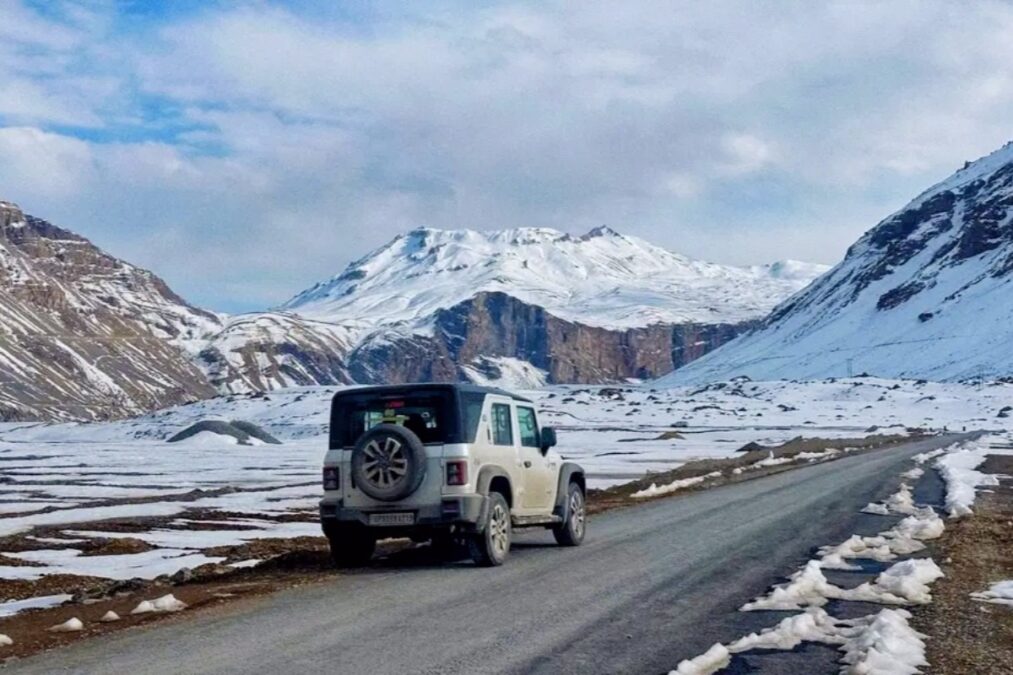
Ladakh is India’s most important snow leopard landscape, and in 2026 it has taken a major step from specialist wildlife expeditions towards regulated high-altitude safari tourism. With an estimated 477 snow leopards, extensive high-altitude habitat and a new government-backed safari programme, Ladakh offers one of the world’s most compelling opportunities to search for Panthera uncia in the wild.
But a snow leopard safari is not a conventional jeep safari. These cats inhabit enormous, rugged mountain landscapes, remain exceptionally well camouflaged and may be separated from an observer by several kilometres of broken terrain. The reward, therefore, comes from combining local tracking knowledge, patience, optics and an understanding of the animal’s prey and winter movements.
Updated: October 2026
What is New: Ladakh’s First High-Altitude Snow Leopard Safari
In October 2026, the Ladakh Administration launched what it describes as India’s first high-altitude wildlife safari, with six specially designed open-back vehicles operated through the Snow Leopard and High-Altitude Nature Conservation (SHAN) Society in collaboration with the Department of Forest, Ecology and Environment, UT Ladakh.
The initial operating areas are Rumbak, Shang and Uley, three locations already known for regular snow leopard encounters. The programme is designed around approved routes, trained local drivers and wildlife guides, rather than unrestricted off-road driving. The administration is also identifying suitable future routes across Hemis National Park, Changthang, Karakoram Wildlife Sanctuary, Nubra, Zanskar, Sham, Kargil and Drass.
This distinction matters: the presence of snow leopards in a protected landscape does not automatically mean that every valley, road or border area is open for tourism.
| Snow Leopard Safari Information | 2026 Status |
|---|---|
| Safari season | November to April |
| Best period for sightings | February to March |
| Initial safari locations | Rumbak, Shang and Uley |
| Safari vehicles | 6 specially designed open-back vehicles |
| Wildlife guide | Trained local wildlife personnel |
| Official safari cost | Not publicly announced yet |
| Daily safari timing | Not publicly announced yet |
| Booking procedure | Official procedure to be confirmed |
| Snow leopard sighting guarantee | No — sightings depend on weather, tracking conditions, prey movement and animal behaviour |
| Future safari landscapes | Hemis, Changthang, Karakoram, Nubra, Zanskar, Sham, Kargil and Drass |
| Recommended acclimatisation | Allow adequate acclimatisation in Leh before travelling to higher-altitude wildlife areas |
How Many Snow Leopards Are There in Ladakh?
The strongest population estimate currently available comes from a major 2025 scientific assessment by the Wildlife Institute of India and Ladakh’s wildlife authorities.
- Estimated snow leopards in Ladakh: 477
- Confidence interval: 380–598
- Estimated occupied area: 47,572 km²
- Sign-survey effort: 6,149 km
- Camera-trap locations: 956
- Camera-trap effort: 97,313 trap nights
- Snow leopard photographs: 26,130
- Individually identified animals: 126
The research identified some of the world’s highest recorded snow leopard densities in parts of Ladakh, with Hemis National Park reaching approximately 2.073 animals per 100 km². The study also found substantial snow leopard use of multi-use landscapes outside strictly protected areas.
Source: Raina et al., PLOS ONE, 2025.
Where Can You See Snow Leopards in Ladakh?
For travellers, the most useful distinction is between established wildlife-watching areas, scientifically confirmed habitat and strategically restricted landscapes.
| Area | Snow Leopard Importance | Tourism Status |
|---|---|---|
| Rumbak | One of Ladakh’s best-known winter sighting areas | Initial 2026 safari area |
| Shang | Regular recent sightings and tracking activity | Initial 2026 safari area |
| Uley | Long-established snow leopard watching landscape | Initial 2026 safari area |
| Hemis National Park | Highest density recorded in the 2025 scientific assessment | Regulated wildlife tourism |
| Nubra–Shyok | 26 individually identified snow leopards in the scientific camera-trap assessment | Habitat; access varies by locality |
| Kargil & Suru | Confirmed snow leopard landscape with recent field records | Wildlife tourism developing |
| Zanskar | Suitable high-altitude snow leopard habitat | Potential regulated safari areas |
| Karakoram | Scientifically important northern habitat | Not an unrestricted safari zone |
Rumbak: The Classic Snow Leopard Valley
Rumbak, inside the Hemis National Park landscape, remains one of the most established snow leopard destinations in Ladakh. Winter concentrates both predators and prey into terrain where experienced local trackers can scan ridges, cliffs, gullies and blue-sheep habitat.
The valley has repeatedly produced close-range wildlife encounters, including winter records of mating animals, mothers with cubs and snow leopards moving around the settlement.
Rumbak is also particularly relevant in 2026 because it is one of the three initial locations officially selected for the new Ladakh Snow Leopard Safari.
Shang Valley: One of the Strongest Recent Sighting Areas
Shang Valley has emerged as one of the most productive locations for specialist snow leopard expeditions. Recent field reports document repeated sightings during multi-day winter searches, including animals moving through rugged slopes and individuals associated with blue sheep.
Its inclusion in the first phase of the government-backed safari is therefore significant: the new programme is not simply creating a tourist attraction, but formalising wildlife viewing around landscapes already known to local trackers.
Uley: Famous, Productive and Scientifically Important
Uley has long been associated with snow leopard tracking in Ladakh. The surrounding valleys provide broken rocky terrain, cliffs and prey-rich slopes that are particularly suitable for the species.
Historical expedition records include adults, cubs and animals around ibex kills, while recent tourism reports continue to describe the wider Uley landscape as an important winter tracking area.
Hemis National Park
Hemis is not merely famous among wildlife photographers; it also produced the highest snow leopard density estimate in the 2025 Ladakh assessment: 2.073 ± 0.278 individuals per 100 km².
The scientific survey used camera traps positioned according to snow leopard signs such as scat, pugmarks, kills and trails. This explains why apparently empty slopes can nevertheless contain a surprisingly high density of animals.
For travellers, the practical lesson is simple: good habitat does not mean easy sightings.
Nubra and the Shyok Valley
The Nubra–Shyok landscape is one of the most interesting northern sectors for snow leopard research. The 2025 assessment used 125 camera-trap locations in its Nubra–Shyok sampling block and identified 26 individual snow leopards.
The broader landscape includes dramatic valleys around Nubra and Shyok, but the scientific evidence should not be interpreted as permission to search randomly for cats. Exact camera locations are not publicly released because precise locations of vulnerable wildlife are restricted.
Travellers can explore accessible parts of Nubra through established routes and villages, while specialist wildlife access farther into the northern sector remains subject to security, permissions and local regulations.
Can You Travel to Murgo for Snow Leopards?
Murgo should not currently be marketed as a normal tourist snow leopard safari destination.
Murgo lies within the strategically sensitive northern Ladakh landscape associated with the Darbuk–Shyok–Daulat Beg Oldi corridor. The wider region contains scientifically important snow leopard habitat, but roads towards Murgo, DBO and the Karakoram sector cannot be treated in the same way as the established tourist circuits of Nubra.
Similarly, Daulat Beg Oldi, Karakoram Pass, Saser Brangsa and Gapshan should not be presented as ordinary public wildlife-viewing destinations.
This is an important distinction for responsible tourism: scientific presence is not the same as tourist accessibility.
Karakoram Wildlife Sanctuary
The Karakoram landscape is part of the wider northern snow leopard ecosystem, and the Ladakh Administration has identified the Karakoram Wildlife Sanctuary among the areas where suitable future high-altitude safari routes may be developed.
However, as of 2026, the officially launched safari begins with Rumbak, Shang and Uley. Karakoram should therefore be regarded as a potential future regulated wildlife-safari landscape rather than an open destination where independent travellers can drive off-road looking for snow leopards.
Snow Leopard Sightings in Ladakh: 2020–2026
Long-running specialist expedition records show how dramatically sighting opportunities can vary between seasons.
| Season | Published Expedition Record |
|---|---|
| 2020 | 30 snow leopard sightings over 34 tracking days in one long-running expedition dataset |
| 2021 | Private departures; the operator reports sightings on every expedition |
| 2022 | 38 sightings over 41 tracking days |
| 2022–23 | 106 sightings over 88 field days |
| 2023–24 | 139 sightings over 127 guest tracking days |
| 2025–26 | Multiple expedition and local sighting records, but no comparable territory-wide annual tourism total |
These figures are operator-specific expedition records, not a government census. They should therefore never be presented as the number of snow leopards living in Ladakh.
Recent Snow Leopard Locations Reported by Field Expeditions
Recent specialist reports have documented snow leopard encounters around Shang, Rumbak, Hemis Shukpachan and other Hemis-region valleys. A 2025 expedition report recorded nine sightings involving 12 individual snow leopards during one 10-day expedition, while local observers also reported animals around Likir.
These records demonstrate the value of local knowledge: villagers, trackers and wildlife guides can sometimes locate animals that visiting teams would otherwise miss.
Snow Leopards in Kargil and Suru Valley
The snow leopard story extends well beyond Leh and Hemis.
In March 2025, a snow leopard was documented with an ibex kill in the Sangrah area of Suru Valley, Kargil, providing a significant recent record from western Ladakh.
The 2025 scientific assessment also recorded a substantial snow leopard density in the broader Kargil multi-use landscape: approximately 1.257 ± 0.480 individuals per 100 km².
This makes Kargil particularly interesting for future wildlife tourism, especially as Ladakh expands beyond the established Hemis-based snow leopard circuit.
When Is the Best Time for a Snow Leopard Safari in Ladakh?
November to April is the principal winter snow leopard season.
Winter is advantageous because cold and snow influence prey movement, while snow leopard tracks and contrasting movement patterns can become easier for experienced trackers to interpret. February and March are especially popular for specialist expeditions, although sightings can occur throughout the winter season.
| Month | What to Expect |
|---|---|
| November | Early winter; fewer wildlife tourists and developing snow conditions |
| December | Increasingly cold; good tracking conditions |
| January | Deep winter and challenging high-altitude conditions |
| February | Excellent specialist tracking period |
| March | Strong wildlife interest, longer daylight and continued winter sightings |
| April | Late-season opportunity with improving accessibility in some areas |
How Does a Snow Leopard Safari Work?
A proper snow leopard safari is fundamentally a tracking expedition, not a drive-through wildlife park experience.
- Local trackers inspect slopes and valleys for fresh signs.
- Blue sheep, ibex and other prey concentrations help narrow the search.
- Ridges and opposite slopes are scanned with high-powered optics.
- Once a cat is located, vehicles or observers reposition without unnecessarily approaching it.
- The animal is watched from a responsible distance while its behaviour remains undisturbed.
The best sightings can last seconds; others may develop into hours of observation when the animal is resting or moving slowly across a distant slope.
What Are the Chances of Seeing a Snow Leopard?
No ethical wildlife operator should guarantee a sighting. Snow leopards have enormous home ranges, exceptional camouflage and unpredictable movements.
Long-running specialist expedition records nevertheless demonstrate that experienced local tracking teams can achieve remarkably high encounter rates. One established Ladakh operator reports sightings on every scheduled expedition since 2017, with 139 sightings recorded over 127 guest tracking days during its 2023–24 season.
The statistic should be interpreted as evidence of tracking expertise and site selection, not as a guarantee for every visitor.
How Much Does a Snow Leopard Safari Cost?
The price varies dramatically according to whether you choose the new regulated local safari model, a specialist expedition, accommodation category, vehicle arrangement and the number of days spent in the field.
There is no single government-wide “snow leopard safari price” for Ladakh in 2026. Visitors should confirm the current rate, vehicle availability, guide arrangements and applicable permissions directly before booking.
How Many Days Do You Need?
For a conventional Ladakh holiday with wildlife interest, 8–10 days can combine Leh, Nubra and other major landscapes. A dedicated snow leopard expedition should ideally allow 5–10 or more wildlife-search days, because additional field time compensates for the unpredictability of the animal.
If snow leopard photography is the primary objective, spending more nights in the wildlife landscape is generally more valuable than adding another sightseeing destination.
What Equipment Should You Carry?
- High-quality binoculars
- 20–60× or comparable spotting scope where available
- Camera with a long telephoto lens
- Extra batteries and memory cards
- Windproof and insulated winter clothing
- UV-protection sunglasses
- Sunscreen and lip protection
- Water bottle and personal medicines
- Power bank and offline maps
Never use a laser pointer, drone or loud sound to attract a snow leopard. A photograph is never worth disturbing a wild animal.
Responsible Snow Leopard Tourism
Ladakh’s new safari model has been designed partly to reduce illegal off-roading and uncontrolled wildlife disturbance. Visitors should stay on authorised routes, follow their guide’s instructions, avoid crowding an animal and never attempt to approach a snow leopard on foot merely to obtain a closer photograph.
The principle is simple: the animal should change its behaviour as little as possible because you are there.
Snow Leopard Habitat and Prey
Snow leopards are closely tied to rugged terrain and prey availability. Blue sheep, Himalayan ibex and other mountain ungulates are particularly important prey, while livestock can also become involved in human-wildlife conflict.
This explains why productive snow leopard valleys are rarely just “beautiful mountains”: they are functioning ecosystems in which cliffs, grasslands, prey, water and seasonal movement corridors interact.
Why Ladakh Is So Important for Snow Leopards
The 2025 scientific assessment estimated that Ladakh contains approximately 477 snow leopards, representing one of the world’s largest contiguous populations. Around 61% of the estimated population predominantly occurs in multi-use landscapes, demonstrating that conservation cannot depend solely on protected-area boundaries.
Local communities are therefore central to the future of snow leopard conservation. Responsible wildlife tourism can turn the presence of an elusive predator into an economic incentive for protecting habitat rather than disturbing it.
Ladakh Snow Leopard Safari vs Normal Ladakh Tour
| Snow Leopard Safari | Normal Ladakh Tour |
|---|---|
| Wildlife is the primary objective | Landscape, culture and sightseeing are the primary objectives |
| Winter-focused | Usually concentrated in the warmer travel season |
| Long observation periods | Multiple sightseeing stops |
| High-powered optics and trackers | Standard sightseeing equipment |
| Flexible daily searching | Fixed sightseeing itinerary |
| Greater emphasis on wildlife ethics | General responsible tourism |
Can You Combine a Snow Leopard Safari With a Ladakh Holiday?
Yes. A carefully planned itinerary can combine a wildlife experience with the major landscapes of Ladakh, including Leh, Nubra Valley, Pangong Lake, monasteries, high mountain passes and local villages.
For a broader holiday, explore the Ladakh Tour Packages by SetMyTrip and customise the sightseeing component around your wildlife-search dates.
For destination planning, our detailed Places to Visit in Ladakh guide covers the major valleys, monasteries, lakes, villages and high-altitude attractions that can be combined with a wildlife itinerary.
Frequently Asked Questions About Snow Leopard Safari in Ladakh
Where is the best place to see a snow leopard in Ladakh?
Rumbak, Shang and Uley are among the strongest established wildlife-viewing areas, and they are the initial operating locations of Ladakh’s 2026 high-altitude safari.
Is Rumbak good for snow leopard sightings?
Yes. Rumbak has a long record of winter snow leopard observations and is one of the three initial areas selected for the 2026 regulated safari.
Can I see snow leopards in Nubra Valley?
Snow leopards are scientifically confirmed in the broader Nubra–Shyok landscape, but sightings are unpredictable and not every tourist-accessible part of Nubra is a snow leopard viewing site.
Can tourists travel to Murgo?
Murgo is in a strategically sensitive northern sector and should not be treated as an ordinary tourist snow leopard safari destination. Access beyond established tourist routes is subject to security and administrative restrictions.
Can tourists go to Daulat Beg Oldi for snow leopard photography?
DBO is a strategically sensitive military area and is not a conventional public wildlife-tourism destination. Scientific evidence of habitat should not be interpreted as unrestricted tourist access.
Is Karakoram Wildlife Sanctuary open for snow leopard safari?
The Ladakh Administration has identified Karakoram Wildlife Sanctuary among the landscapes where suitable regulated safari routes may be developed, but the initial 2026 safari operates in Rumbak, Shang and Uley.
What is the best month for snow leopard sightings?
February and March are particularly popular among specialist expeditions, although snow leopards can be encountered throughout the principal November–April winter season.
How many snow leopards are there in Ladakh?
The 2025 scientific assessment estimated 477 snow leopards in Ladakh, with a confidence interval of 380–598.
Are snow leopards dangerous?
Snow leopards are elusive wild predators that normally avoid people. The correct approach is to maintain distance, remain quiet and follow trained wildlife guides.
Can I guarantee a snow leopard sighting?
No. Even in highly productive habitat, sightings depend on weather, prey movement, animal behaviour, tracking conditions and luck. No ethical operator should promise a guaranteed wild-animal encounter.
Final Verdict: Is a Ladakh Snow Leopard Safari Worth It?
Absolutely—if you treat it as wildlife tracking rather than a sightseeing excursion. Ladakh combines one of the world’s largest snow leopard populations with extraordinary high-altitude ecosystems, and the 2026 launch of a regulated safari gives visitors a new, more structured way to experience that landscape.
The strongest approach is to begin with the established areas—Rumbak, Shang and Uley—and use trained local trackers rather than attempting to chase animals independently. Northern landscapes such as Nubra–Shyok and Karakoram are scientifically fascinating, but sensitive sectors around Murgo, DBO and the Karakoram frontier should never be promoted as unrestricted wildlife-tourism routes.
For the traveller willing to spend cold mornings behind a spotting scope, scan seemingly empty cliffs for hours and let the mountains reveal their secrets at their own pace, Ladakh offers something few wildlife destinations can: the possibility of watching one of the world’s most elusive cats living entirely on its own terms.
Sources & Further Reading
- Ladakh Administration – India’s First High-Altitude Snow Leopard Wildlife Safari
- Ladakh Administration – High-Altitude Wildlife Safari Announcement
- PLOS ONE – Comprehensive Assessment of Snow Leopard Distribution and Population in Ladakh
- Voygr – Snow Leopard Expedition Tracking Records
- Voygr – 2023/24 Snow Leopard Season Report
- SetMyTrip – Ladakh Tour Packages
- SetMyTrip – Places to Visit in Ladakh
Research note: Scientific camera-trap data and operator sighting records are different types of evidence. Camera-trap results demonstrate population and distribution; expedition records describe encounters during particular field periods. Exact locations of vulnerable snow leopards are deliberately not published by researchers, so responsible travel information should never disclose sensitive coordinates or encourage off-road pursuit.
“`0
